On site
Barbados Still Has No Mandatory Building Code: What Your House Is Built To
Jahmal Springer
Lead Designer, Blue Island Projects
30 June 2026 · 5 min read
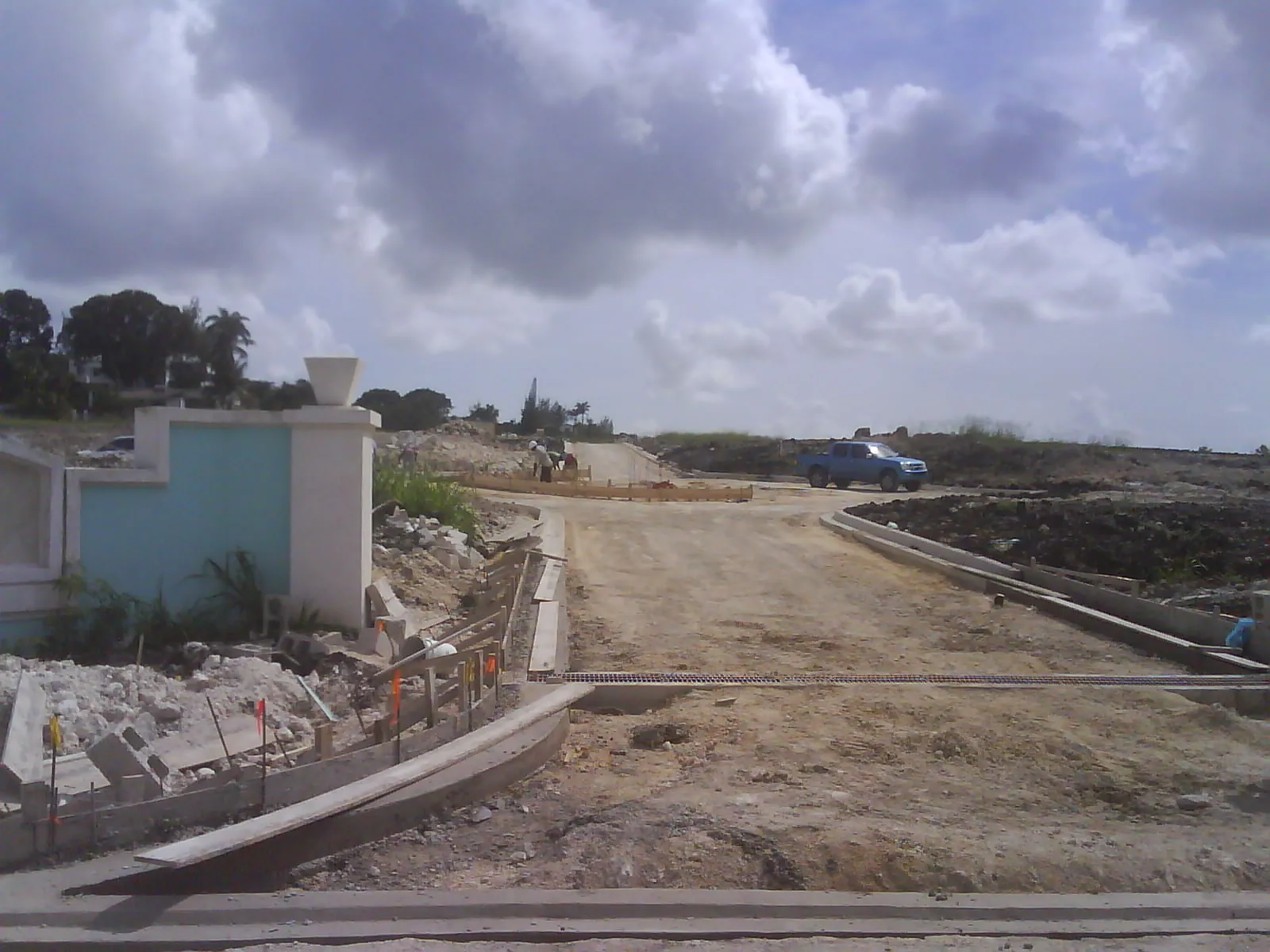
New residential construction in Christ Church. Without a mandatory national building code, the standard a house is built to is set by the professionals and contractors on the job.
Barbados has building standards, a standards authority and a wind-load standard. Without a single mandatory national building code, the design team must state which standard applies to the house.
A drawing can be approved and still be under-designed
There is a gap in Barbadian construction that most homeowners never see. A set of drawings can pass planning, a contractor can build it exactly as drawn, an inspector can visit the site — and nothing in that sequence guarantees that the roof was engineered for the uplift a hurricane will put on it.
That is because Barbados has long operated with a national building code that functions as guidance rather than as a legally enforced instrument applied to every house. Successive governments have worked on the framework: the Building Standards Authority sits within the Ministry of Transport, Works and Water Resources, and the Barbados National Standards Institution publishes national standards, including standards covering wind loading. What has been missing is a single mandatory code, applied uniformly to residential construction, with inspection and enforcement behind it.
I want to be careful here, because this is not a scandal story. Plenty of Barbadian houses are well built by careful contractors who have learned from storms. The point is narrower and, in my view, more useful: in the absence of a mandatory code, the standard your house is built to is a decision somebody makes — and if the designer does not make it deliberately, it gets made by default.
“Where the code is voluntary, the standard becomes a design decision. Somebody has to make it on purpose.”
New concrete-block housing at South View, Christ Church. Barbadian residential construction is dominated by block and cast slabs — a system that performs very well in wind when the connections between roof, walls and foundation are engineered, and poorly when they are assumed.
What actually exists to design against
The absence of a mandatory code does not mean the absence of numbers. Three bodies of guidance are available to any designer working here.
- The Caribbean Uniform Building Code (CUBiC), the regional framework developed in the 1980s specifically to give Caribbean construction wind and hurricane provisions.
- Barbadian national standards published through the Barbados National Standards Institution, including wind load provisions derived from that regional work.
- International standards — most commonly the ASCE 7 wind load standard referenced through the International Building Code — which give current, tested pressures, exposure categories and load combinations.
On a Barbadian house, I design the structure to a stated wind standard and write it on the drawings. This gives the client, contractor and insurer a clear record of the assumptions, whether or not a regulator asks for it.
The distinction that matters
A code is a legal instrument. A standard is a technical document. Barbados has had access to good standards for decades; what has lagged is mandatory, uniformly enforced application of them to ordinary houses.
Practical consequence: when nobody is legally obliged to check, the quality of your building depends on the competence and honesty of the people you hire — which is why who you engage matters more here than in a jurisdiction with strict enforcement.
What the storms have already told us
Barbados sits at the eastern edge of the hurricane belt and is often described locally as fortunate. That framing is risky, because the island's recent damage has come from systems that were never direct major-hurricane hits.
Tropical Storm Tomas in 2010 brought down trees and power lines, damaged roofs, and caused enough structural damage along the Bridgetown waterfront that engineering assessments and repairs kept a road closed for weeks. In July 2021, Hurricane Elsa passed close to the island as a compact Category 1 system and, according to reporting from Barbadian authorities and regional agencies, damaged roofs on well over a thousand homes, destroying some outright.
Neither event was a worst case. Both did most of their building damage in the same place: the roof, and the connection between the roof and everything below it.
Before → Now → Proposed
BEFORE
Highway 1 at Holetown after Tropical Storm Tomas, 2010. Tree and utility failures interrupt access and power long before the wind is strong enough to threaten a well-built structure.
Photograph: CaribDigita, CC BY-SA 3.0, via Wikimedia Commons
NOW
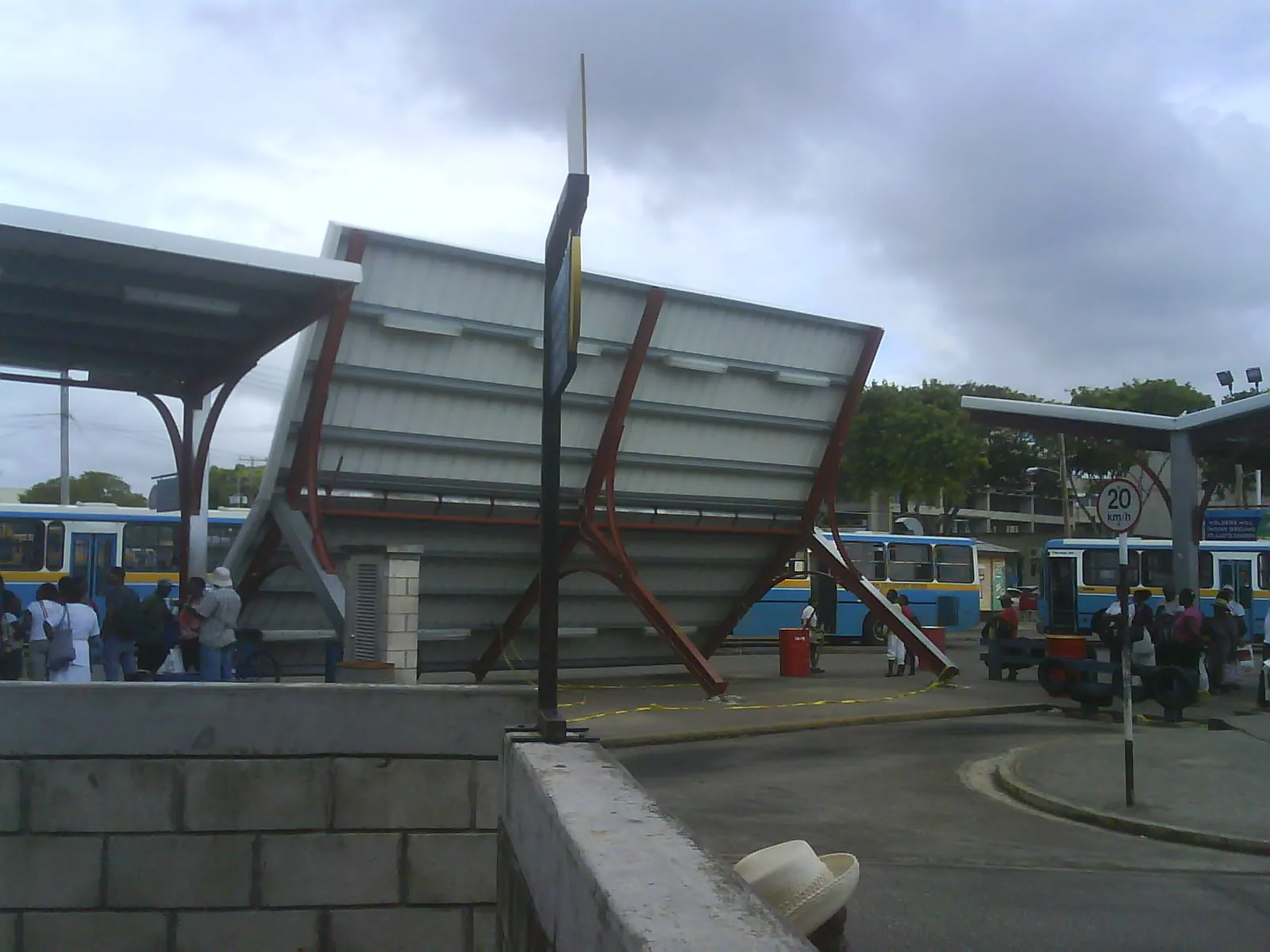
Damage to the berths at Princess Alice Bus Terminal, Bridgetown, in 2010. Long-span, lightly clad structures are the most exposed elements in a Barbadian storm — they catch wind and have the fewest redundant load paths.
Photograph: CaribDigita, CC BY-SA 3.0, via Wikimedia Commons
Two 2010 records from Tropical Storm Tomas — a storm that was not a hurricane when it affected Barbados, and still produced weeks of repair work.
Where houses fail, and why it is nearly always the same place
Wind does not push a roof down. It lifts it. Air accelerating over a roof plane creates suction on the outside while pressure builds inside the house the moment a window or door fails. The roof is then being pulled up and pushed up at once.
On every project I trace a continuous, engineered path for uplift force from the sheeting, through the purlins and rafters, into the ring beam, down the walls and into the foundation. No connection along that route should depend on a decision made casually on site.
The load path a Barbadian roof needs
- 01
Wind uplift
Suction on the roof surface, amplified at edges, ridges and corners.
- 02
Sheeting and fixings
Fastener type, spacing and edge zones specified — closer at perimeters, not uniform across the roof.
- 03
Rafters and purlins
Members sized for uplift reversal, not only for downward dead and live load.
- 04
Roof-to-wall tie
Straps or engineered anchors into the ring beam, installed as detailed and inspected before covering.
- 05
Walls and reinforcement
Continuous vertical reinforcement tying block work to the beam above and the base below.
- 06
Foundation
Uplift resolved into mass and ground — where the load path finally stops.
The other half of the problem is openings. Once a window or door fails, internal pressure rises and the roof loading changes character entirely. Impact-rated glazing or proper shutters are not a luxury item on a Barbadian house; they are part of the structural strategy.
“Roof strength depends on the openings holding as well as the roof connections.”
The vernacular already understood this
I keep coming back to the chattel house roof for this reason. A steep, simple gable with a short overhang is not a stylistic choice — it sheds wind, avoids the large uplift zones a wide flat overhang creates, and puts the whole roof in one geometric family so forces stay predictable.
A chattel house roof: steep, symmetrical, small overhang, simple ridge line. Builders working without engineering software arrived at a geometry that behaves well in wind and sheds heavy rain quickly.
Photograph: rufus (Flickr), CC BY 2.0, via Wikimedia Commons
I would not pretend the old buildings were invincible. Timber, loose block foundations and hand-driven nails all have limits, and storms took plenty of these houses. What survives is the logic, not the specification: keep the roof form simple, keep the overhangs disciplined, and keep everything connected.
What this means if you are building or renovating now
The practical response to a voluntary code is careful documentation. Ask for the wind standard in writing, and ask to see the connection details before the roof goes on — because after the sheeting is fixed, nobody can verify what is underneath it.
Before you build or re-roof in Barbados
- 01Ask, in writing, which wind load standard the structure has been designed to.
- 02Ask for a drawn roof-to-wall connection detail, not a verbal assurance.
- 03Have the roof structure and straps inspected before sheeting is fixed.
- 04Specify fastener type and spacing, with closer spacing at edges, ridges and corners.
- 05Protect every opening with impact-rated glazing or shutters on all elevations.
- 06Check gutters, downpipes and site drainage: most storm damage here is water finding a path, not wind lifting a wall.
- 07Keep the roof geometry simple; every extra valley, dormer and wide overhang adds a place for wind to work.
- 08Keep the drawings, calculations and product data — they matter for insurance and resale.
THE BLUE ISLAND TAKE
The interesting thing about a voluntary code is what it reveals about a design practice. When compliance is not the driver, the standard you hold yourself to becomes visible. I would rather a client pay for engineering time than for a reconstruction, and I would rather explain a specification now than a failure later.
In my work, that means treating the whole envelope as one connected system — roof, openings, walls, foundation, drainage — and being explicit on the drawings about what it is designed to resist. It also means keeping the geometry simple enough that the contractor can build the detail correctly on a hot afternoon in August, because a detail that is only right on paper is not right at all.
Barbados will get to a mandatory, enforced code. Until then, the standard your house is built to is a matter of who you hired and what they wrote down.
Related reading
- Building for the Next Hurricane, Not the Last One
Why the storm that spared your house is the wrong benchmark for the next one.
- What the Chattel House Still Teaches Us About Building in Barbados
Roof geometry, modularity and repairability in the island's oldest small-house tradition.
- From the Nineties to Now: How Barbadian Architecture Actually Changed
How hurricane engineering moved from optional upgrade to standard conversation.
Codes establish legal minimums, while standards provide the technical basis for design.
Wind acts on the house regardless of which document was legally required.
State the design standard clearly and build every connection to it.
Jahmal Springer
Lead Designer, Blue Island Projects
Sources & further reading
- Building Standards Authority — Ministry of Transport, Works and Water Resources
- Barbados National Standards Institution — national standards, including wind loading
- CDEMA — Caribbean Disaster Emergency Management Agency, regional damage reporting
- Barbados Meteorological Services — hurricane season and wind advisories
- Barbados Institute of Architects — professional practice and standards
- UNDRR — guidance on land use, planning and building regulation