Sustainability
Designing Toward Barbados' 2030 Renewable Energy Goal — One Roof at a Time
Jahmal Springer
Lead Designer, Blue Island Projects
9 June 2026 · 4 min read
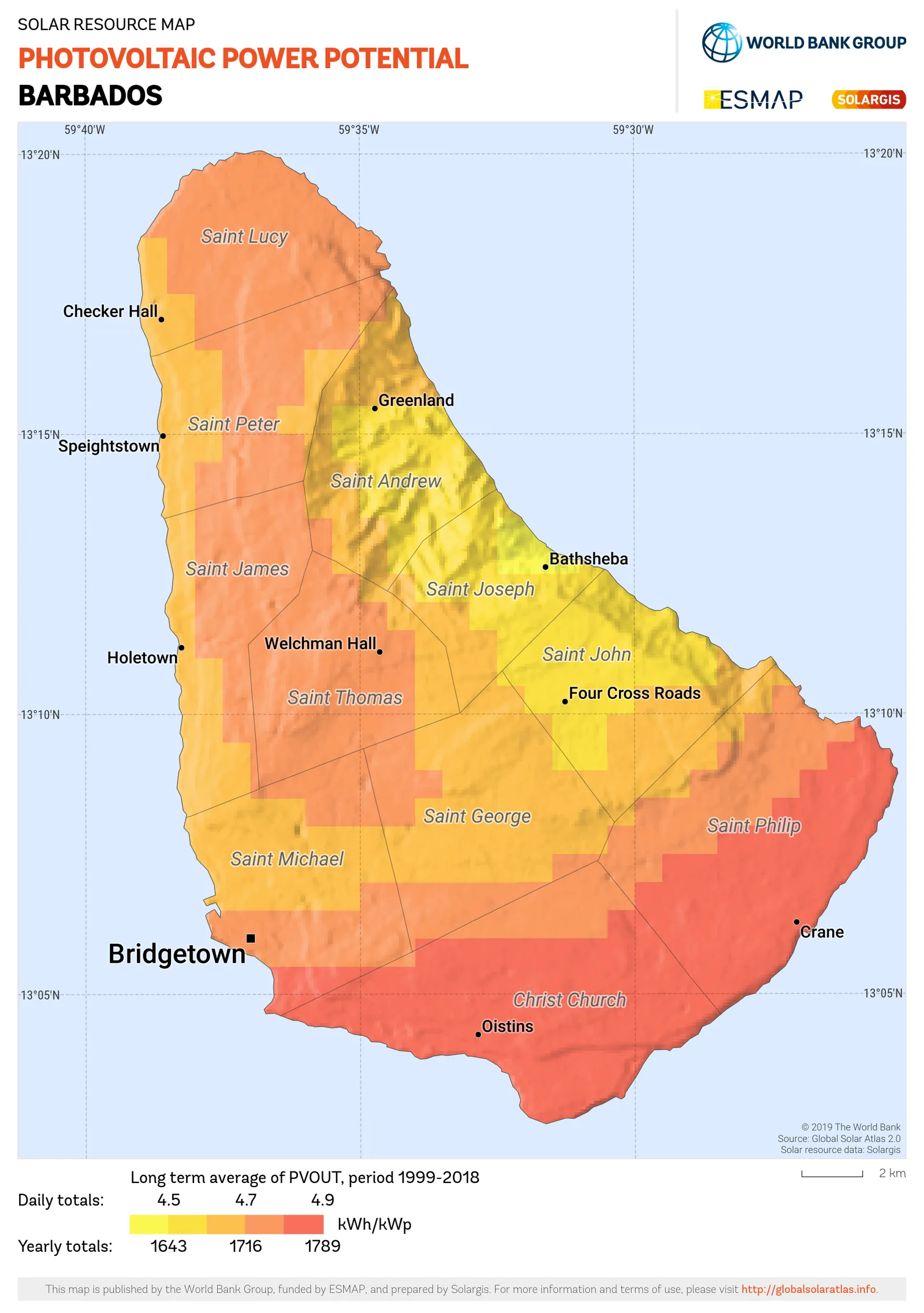
Barbados' photovoltaic power potential. The island's solar resource is strong and remarkably even — which is why roof geometry, shading and structure matter more here than location does.
Map: Solargis / World Bank ESMAP Global Solar Atlas, CC BY 4.0
Barbados has committed to 100% renewable electricity and carbon neutrality by 2030. Most of that will be decided on ordinary rooftops — and a roof either is or isn't ready when the client can finally afford panels.
The roof is the most valuable surface on a Barbadian house
Barbados normalised the idea of a working roof long before anyone called it sustainability. Drive through any parish and count the solar water heater tanks. By the early 2010s the island had tens of thousands of installations against a population of roughly 280,000 — an adoption rate that put Barbados among the world leaders in solar water heating per person.
That happened without a mandate. It happened because the payback was obvious, the technology was simple, and a local manufacturing and installation industry grew up around it.
Now the country has set a far harder target: the Barbados National Energy Policy 2019–2030 commits the island to 100% renewable energy and carbon neutrality by 2030. Most of that will be decided by utility-scale generation, storage and transport policy. But a meaningful share of it gets built one roof at a time — and every one of those roofs is drawn by someone.
“A roof either does energy work or it doesn't. That is decided at design stage, not at move-in.”
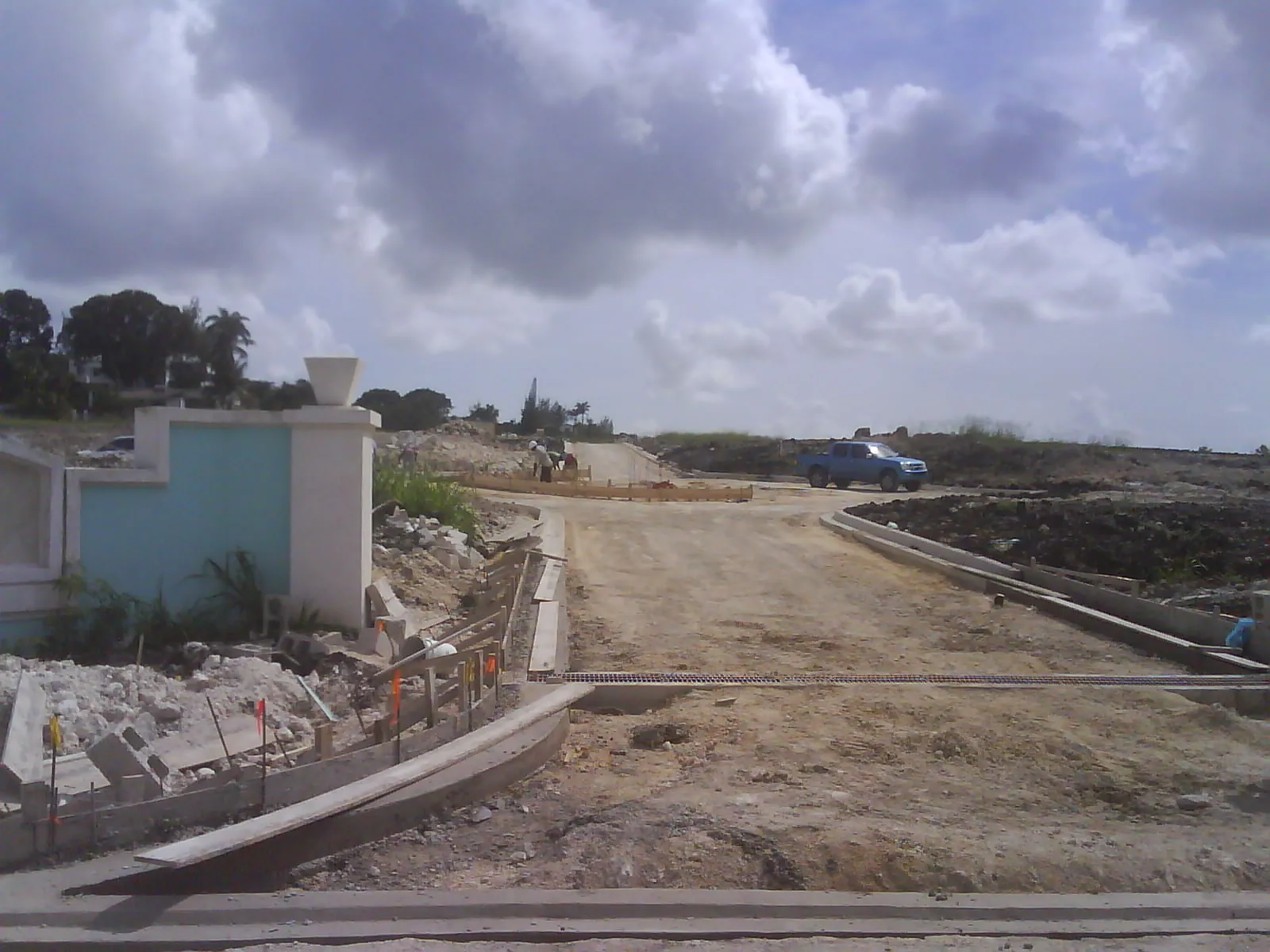
New housing at South View, Christ Church. The roof pitch, orientation and structural capacity being set here will determine, for decades, how much energy this house can generate and how much cooling it will demand.
What the resource data actually says
Barbados has a strong and consistent solar resource. The Global Solar Atlas, produced by Solargis for the World Bank's ESMAP programme, maps photovoltaic power output potential across the island and shows high, evenly distributed potential rather than a few favoured pockets.
Consistency matters more than peak intensity for a house. A low-latitude island with small seasonal swing means a modest array produces usefully all year, which makes sizing decisions far less speculative than they are in a temperate climate.
Photovoltaic power output potential across Barbados, from the Global Solar Atlas. The resource is strong island-wide. On most homes, roof geometry, shading and structure become the limiting factors.
Map: Solargis / World Bank ESMAP, Global Solar Atlas, CC BY 4.0
Read the resource honestly
A strong resource map tells you the sun is available. It does not tell you your roof can use it.
In practice the constraints on a Barbadian house are local: a roof plane facing the wrong way, a neighbouring tree, a water tank, an air-conditioning condenser platform, or a structure never designed to carry an array and its wind loads.
Reduce demand before adding panels
Here is the part I find myself explaining most often. If a house needs a large mechanical cooling load to be habitable, renewable generation is preferable to imported fuel. Reducing the load through design remains the less expensive move.
Every watt you design out of the house is a watt you never have to generate, store, inverter, insure or replace in fifteen years. So the order I work in is: reduce the load, then meet it.
The order I design a low-energy Barbadian house in
- 01
Orientation
Long facades to the north-east trades; minimise west-facing glazing that takes the full afternoon load.
- 02
Shade
Overhangs, verandas, louvres and screens sized for our sun angles — stopping heat before it reaches the wall.
- 03
Airflow
Cross ventilation and high-level relief so the building can shed heat without a compressor.
- 04
Envelope
Roof insulation, light-coloured roof surfaces and considered thermal mass to slow heat gain.
- 05
Efficient systems
Right-sized inverter split units, efficient appliances, LED lighting, solar or heat-pump hot water.
- 06
Generate
PV sized against the reduced load — with the roof structure, conduit routes and inverter space designed in from day one.
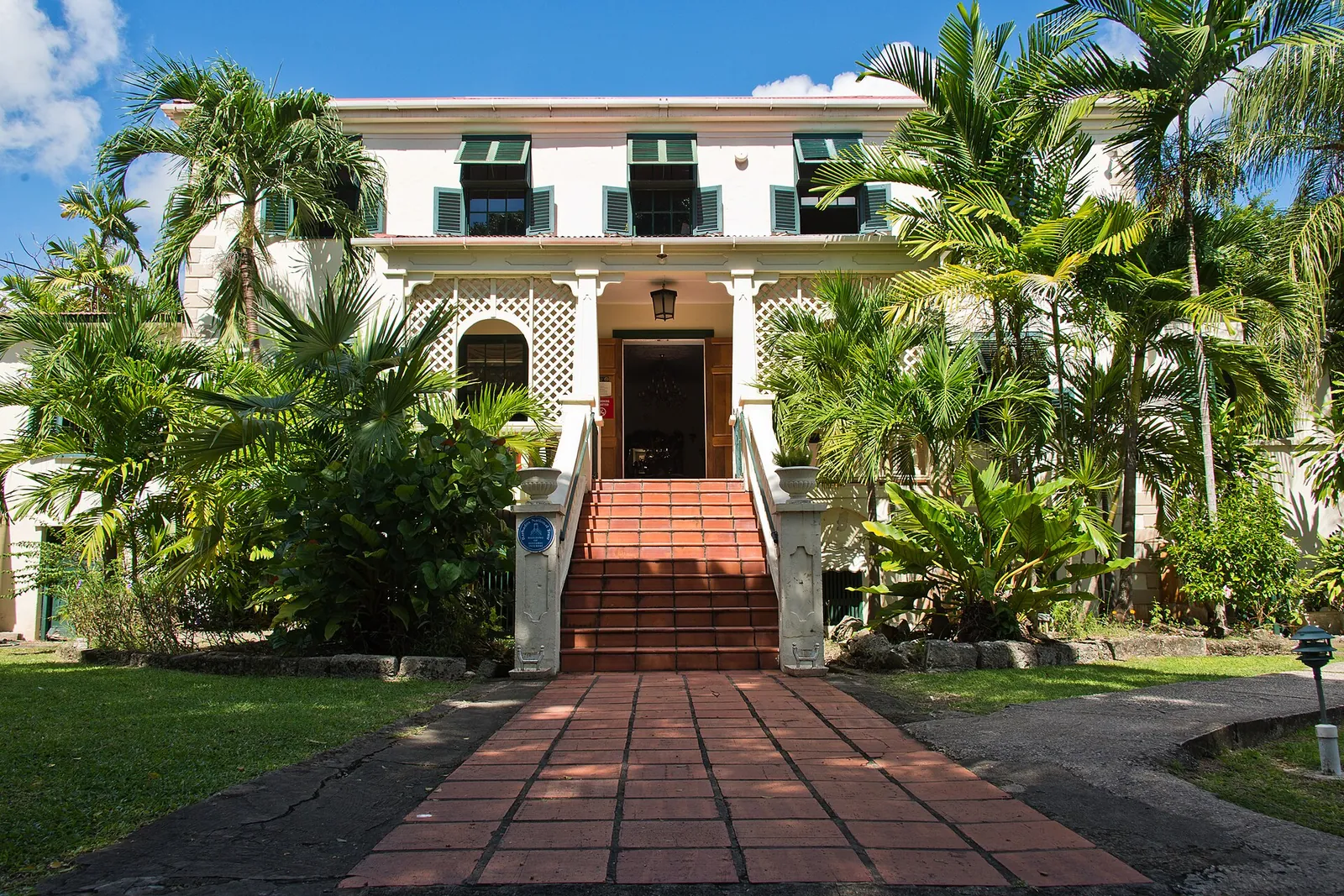
Sunbury Plantation House. The shaded arcade and louvred openings are load reduction — the eighteenth-century version of specifying a smaller system.
Photograph: Barry Haynes, CC BY-SA 4.0, via Wikimedia Commons
Designing for a grid that is changing under you
Rooftop generation in Barbados does not exist in isolation. It sits inside a regulated relationship with Barbados Light & Power, with connection arrangements and renewable energy rider terms determined through the Fair Trading Commission. Those terms have changed before and will change again.
In my view that is an argument for designing the building to be adaptable rather than optimising it around today's tariff. A house that can accept more panels, a battery, a second inverter or an EV charger later is worth more than one tuned perfectly to the rules of the year it was built.
Barbados Light & Power's head office on Bay Street. Connection terms, metering arrangements and rider tariffs set through the regulator shape what a rooftop system is worth — which is why flexibility in the building matters more than optimisation to current rules.
Photograph: CaribDigita, public domain, via Wikimedia Commons
Panels and hurricanes have to be designed together
This is the constraint that gets skipped, and the one that concerns me most. An array is a set of stiff panels held clear of a roof surface in a hurricane belt. Mounted carelessly, it becomes both a sail and a set of point loads on a structure that was never asked to carry them.
A rooftop array in Barbados needs the same engineering attention as the roof itself: rail layout and fixing pattern designed for uplift, penetrations properly flashed, panels kept clear of edge and ridge zones where suction peaks, and roof framing checked for the added load before anything is drilled. Retrofitting that structural capacity later costs far more than allowing for it on the first drawing.
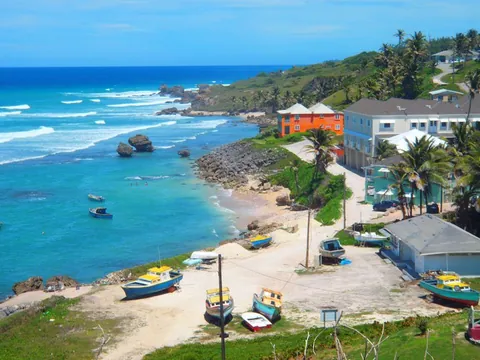
Coastal buildings on the west of the island. Salt-laden air is part of the specification here: fixings, rails and enclosures on a seaside roof need corrosion resistance chosen for marine exposure, not a generic catalogue selection.
“A solar array is a structural element with an electrical function. Design it in that order.”
What this means if you are building or renovating now
Making a Barbadian house ready for 2030
- 01Ask for at least one roof plane with good solar orientation, unshaded and uncluttered by tanks or plant.
- 02Have the roof structure designed to carry a future array and its uplift loads, even if you install nothing now.
- 03Run spare conduit from roof to service position, and leave wall space for inverters and a future battery.
- 04Provide an EV-capable circuit at the parking position while the walls are open.
- 05Specify marine-grade fixings and flashing details for any coastal roof penetration.
- 06Spend on shade, ventilation and roof insulation before spending on generation capacity.
- 07Keep solar hot water in the conversation — it is proven here and takes a real load off the electrical system.
- 08Keep the array off roof edges and ridges, where wind suction is highest.
THE BLUE ISLAND TAKE
Barbados has already proved once that when a technology genuinely suits this island, adoption here can be fast and near-universal. Solar water heating did not need a mandate; it needed an obvious return and a trade that knew how to install it.
The 2030 target will be met mostly by decisions above the level of any single house. But the houses being drawn now will still be standing in 2050, and the ones that were designed to demand less and generate more will simply be cheaper and more comfortable to live in — regardless of what the national numbers end up saying.
What I take from this is a discipline rather than a product: treat energy as part of the architecture, not as equipment bolted on after handover.
Related reading
- Verandas, Jalousies, and Trade Winds: The Passive Cooling Playbook
How to reduce the cooling load before you size anything mechanical.
- Barbados Still Has No Mandatory Building Code
Why the wind standard on your drawings also governs what you can safely mount on the roof.
- From the Nineties to Now: How Barbadian Architecture Actually Changed
How the roof went from a shedding surface to a generating one.
The cheapest kilowatt-hour on this island is still the one the building never needed.
Generation follows load reduction.
Design the load down, then design the roof to carry the rest.
Jahmal Springer
Lead Designer, Blue Island Projects
Sources & further reading
- Barbados National Energy Policy 2019–2030 — Government of Barbados
- Barbados Government Information Service — energy transition announcements
- Global Solar Atlas — Barbados solar resource and PV potential data (World Bank / ESMAP / Solargis)
- Fair Trading Commission Barbados — electricity rates and renewable rider decisions
- Barbados Light & Power Company — grid connection and metering information
- Barbados Meteorological Services — climate and solar radiation records
- IRENA — renewable energy publications and small island energy transition research