On site
Bridgetown After the Water: What Rehabilitating the Careenage Can Teach Us About Building for Flooding
Jahmal Springer
Lead Designer, Blue Island Projects
27 August 2026 · 9 min read
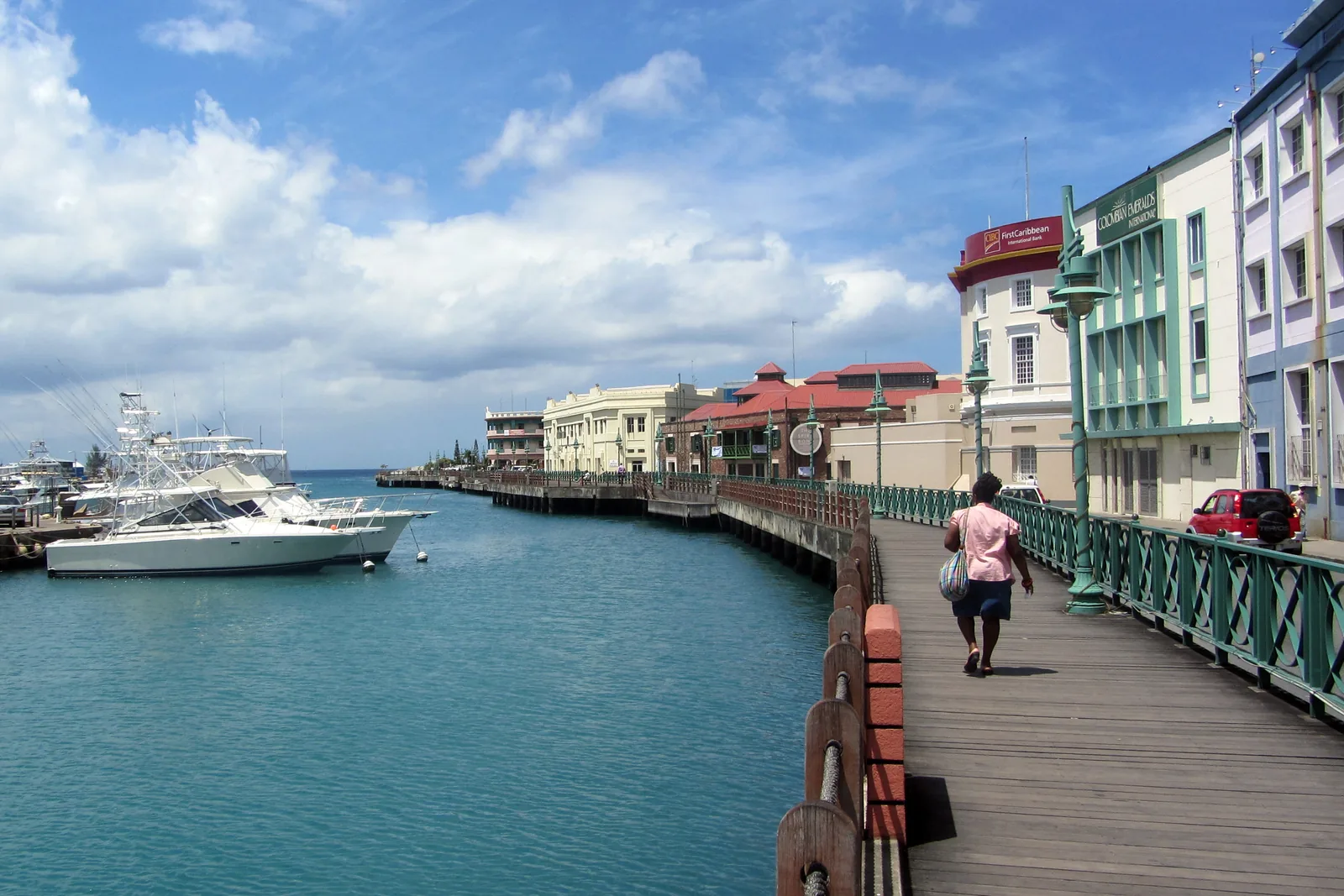
The Careenage remains the physical reminder that Bridgetown's history has always been tied to water. The historic port developed around the Constitution River and provided sheltered anchorage and dock facilities (UNESCO World Heritage Centre).
Bridgetown was shaped by water. The mistake is thinking the city can be rehabilitated without understanding it.
Restoration in Bridgetown usually begins with the visible fabric: façades, coral stone, Georgian proportions, shopfronts, warehouses and streets.
They matter, but rainfall makes the first architectural concern more immediate: the route the water will take through the city.
Bridgetown developed around water, and that history should guide how the city is rehabilitated for the next century.
“Bridgetown grew around the Constitution River and the sheltered water of the Careenage.”
Bridgetown's water problem is still a live design issue
In May 2026, Barbados TODAY reported that improvements to the Constitution River Terminal, alongside a wider programme of drain clearance, were among the upcoming initiatives of the Ministry of Transport and Works.
The 2021 reporting on the Constitution River upgrade described works including dredging, canal cleaning, culverts, wetland areas and a sewage lift station, intended in part to address drainage and water quality.
These current works make water management an active national infrastructure issue, with direct consequences for architecture.
The city began at the water
The area we now call Bridgetown was originally a wet landscape around the Constitution River. The central core was swamp, subsequently drained and filled as the town developed, and a bridge spanning the river became fundamental to the settlement's identity — eventually giving Bridgetown its name.
Source: Visit Barbados — History of Bridgetown
The waterway was not an inconvenience at the edge of the city. It was the reason the city existed. The Careenage provided sheltered water for small vessels, together with facilities for anchoring, shipbuilding and maintenance, and by the seventeenth century the waterfront had become an important commercial centre connecting Bridgetown to the wider Atlantic trading network.
Source: UNESCO — Historic Bridgetown and its Garrison
The Careenage at Bridgetown in the mid-nineteenth century. The historic port developed around the Constitution River, which provided sheltered anchorage and dock facilities.
Percy William Justyne, c.1848 — public domain, via Wikimedia Commons
Today’s Bridgetown still carries that origin. The waterway belongs to the city’s structure and history.
Then we started fighting the water
As Bridgetown expanded, the relationship changed. The Constitution River, the Careenage and the remaining swamp edges were progressively altered, and in 1962 the river and Careenage system was filled and replaced in sections by a channelised canal. This followed the construction of the Bridgetown Deep Water Harbour in 1961, which shifted much of the port activity away from the historic Careenage.
Source: Visit Barbados — History of Bridgetown
Development changed the water system itself, with consequences that remain visible in the city’s drainage.
Today the Constitution River remains an important drainage system. Barbados' National Wetlands Inventory identifies it as the island's largest watershed and records the restored Constitution River estuary as directly connected to the sea. The inventory also notes that floodwaters transport waste into the area.
Source: Barbados National Wetlands Inventory
Intense rainfall still meets the same geography, now covered by considerably more hard surface, infrastructure and development.
The channelised Constitution River beside the Fairchild Street terminal. The river remains part of Bridgetown's wider drainage and waterfront system; its rehabilitation included channel works, dredging, culverts and wetland areas intended to improve drainage and water quality.
Photograph: CaribDigita — public domain, via Wikimedia Commons
The Careenage is a drainage system as well as a waterfront
This is one of the things I think we sometimes forget. When we look at the Careenage today we see boats, restaurants, bridges, walkways, historic buildings and visitors. Hydraulically, we are also looking at part of a much larger system.
Rain falling upstream has to move somewhere. The Constitution River carries runoff toward the coast, while the low-lying urban areas around Bridgetown have to accommodate rainfall arriving from both local surfaces and the wider catchment.
Research into coastal hazards in Greater Bridgetown identifies flooding as one of the most direct climate-related risks to the Careenage and the downtown area, and points to drainage limitations and the interaction between coastal flooding, storm surge and sea-level rise.
Source: Frontiers — Human adaptation to coastal hazards in Greater Bridgetown
That means flood resilience cannot be solved building by building. It has to be approached at city scale.
“The city has to work as a system.”
We have already started the work
This is not theoretical. Barbados has already invested in the Constitution River. Phase III of the upgrade, reported by Barbados TODAY in 2020, was an $11 million capital works project intended to address channel capacity, drainage and water-quality issues.
Source: Barbados TODAY — River project to address flooding
By 2021, reporting on the project put its value at approximately $14 million and described dredging, canal cleaning, culverts, wetland areas, a sewage lift station and improvements intended to help address flooding around Halls Road.
Source: Barbados TODAY — Constitution River project on track
That is significant, because it demonstrates something important: Bridgetown's rehabilitation is already an infrastructure project as much as it is a heritage project.
The inner basin of the Constitution River. Upstream runoff, tidal water and urban drainage all meet in the same narrow corridor.
Photograph: CaribDigita — public domain, via Wikimedia Commons
The river project also addressed urban life
The Constitution River project was also connected to urban regeneration. The 2021 project included plans for landscaping, kiosks and commercial activity around the improved corridor, and officials described the work as part of a wider urban renewal effort.
Source: Barbados TODAY — Constitution River project on track
That is exactly the direction I believe Bridgetown needs. We should not separate flood protection from heritage restoration, from economic regeneration, from public space. They are connected.
- A restored building beside a failing drainage system is not resilient.
- A new drainage channel surrounded by dead public space is not successful regeneration.
- A beautifully restored street that is uncomfortable to walk at midday will not bring people back on its own.
The 2026 warning
In August 2026, Barbados experienced multiple flash-flood watches associated with tropical waves and heavy rainfall. On 17 August, the Barbados Meteorological Services warned of flooding in low-lying areas following overnight rainfall, with a further one to two inches possible. Earlier that month another watch warned of roughly 25–50 mm across parts of the island and specifically identified potential impacts on roads, properties and drainage systems.
Source: Barbados TODAY — Flash flood watch, August 2026
Bridgetown already responds to flooding. The next step is to make that response part of design before each event.
What I would do differently at ground level
Here I am giving a professional opinion rather than citing a study. In a flood-prone part of Bridgetown, keeping every drop outside may be unrealistic. The design should therefore account for water entering the building and make recovery manageable.
- Electrical distribution positioned above anticipated flood levels where feasible.
- Critical mechanical equipment kept off the lowest floor.
- Floor finishes selected for moisture tolerance.
- Wall assemblies capable of drying.
- Joinery designed so damaged lower sections can be repaired or replaced.
- Storage that does not depend entirely on vulnerable ground-floor space.
- Escape routes that remain usable during an event.
These are ordinary details, and they determine how quickly a building can reopen.
Design the building to recover
One of the most important changes in thinking is moving from flood prevention to flood recovery. If water enters a ground-floor commercial unit and destroys gypsum board, laminate flooring, built-in cabinetry, electrical equipment, insulation and expensive finishes, the owner can be facing a major reconstruction.
But if the same building has durable floor finishes, replaceable lower wall sections, raised services, washable surfaces and equipment located above the flood level, the recovery process can be dramatically simpler.
“A recoverable building can take damage without turning every flood into a full reconstruction.”
A building prepared for rising water
- 01
Roof
Protect and drain. Gutters, downpipes, flashings and a controlled discharge path.
- 02
Upper floor
Primary occupied and valuable spaces, above the vulnerable level.
- 03
Services
Electrical distribution and critical plant elevated clear of anticipated flood levels.
- 04
Ground floor
Flood-tolerant finishes and replaceable lower wall and fit-out components.
- 05
Street
Controlled drainage, shade and space that can temporarily hold water.
- 06
Careenage
The final receiving environment for the whole catchment.
Keep water out where practical.
Plan the recovery when water crosses the threshold.
Then look up
Once you move above the vulnerable level the priorities change. Now I am thinking about the roof, gutters, downpipes, parapets, flashings, wall junctions, water discharge and the condition of the masonry — because buildings do not only fail during spectacular floods. They fail through years of small water problems.
- A blocked gutter.
- A leaking downpipe.
- A cracked parapet.
- A failed flashing.
- Water repeatedly hitting the base of a wall.
One storm may get the headline. Ten years of uncontrolled water gets the building.
Don't forget the heritage fabric
This becomes particularly important in Historic Bridgetown. UNESCO describes the city's historic character as an exceptionally preserved seventeenth-century urban layout, with its irregular serpentine streets and surviving colonial architecture, and the site includes historic warehouses and dock facilities along the Careenage and Hincks Street.
Source: UNESCO — Historic Bridgetown and its Garrison
These buildings were not designed according to today's building codes. That is not a reason to abandon them. The challenge is to introduce modern resilience without destroying the characteristics that make the place worth preserving — careful interventions, not wholesale replacement.
Let the public realm hold some of the water
Some of the strongest opportunities sit outside the buildings, in courtyards, rear yards, small parks, street edges, planting zones, permeable surfaces and rain gardens where appropriate.
Instead of treating every square metre as something that must rapidly shed water into a pipe, we can ask where water can temporarily stay, where it can infiltrate, where it can be slowed and where it can be safely directed. That is the beginning of sponge-city thinking, and Bridgetown does not have to become a futuristic eco-city to use the principle.
Shade is infrastructure too
There is another form of resilience we overlook. Heat. A city can be perfectly drained and still be uncomfortable. Walk through Bridgetown at midday and the difference between a shaded street and an exposed paved surface is immediately apparent.
Trees and planted areas provide shade, reduce surface temperatures and can contribute to stormwater management. Urban planting therefore belongs alongside drainage, paving, mobility, heritage and public-space design as working climate infrastructure.
The Careenage should become the city's front door again
For centuries the Careenage was one of Bridgetown's primary points of connection to the world. Ships arrived, goods moved, people arrived, businesses formed. The waterfront was productive. Then the centre of gravity shifted: the Deep Water Harbour changed the city's relationship with the old waterfront, and parts of the historic port infrastructure lost their original function.
Source: Visit Barbados — History of Bridgetown
Vessels moored in the Careenage basin, with the historic waterfront behind. Adaptive reuse — not preservation alone — is what keeps this edge of the city occupied.
Photograph: David Stanley (CC BY 2.0), via Wikimedia Commons
The Careenage does not need to become a museum. It can become a contemporary waterfront district that respects its history while supporting restaurants, small businesses, creative studios, offices, housing, cultural spaces, maritime activity, public events and pedestrian life.
“Heritage becomes useful when people use it.”
Don't restore the city into a museum
I do not want a Bridgetown where every building is beautifully preserved but empty. I want people living upstairs and businesses operating downstairs; restaurants in old warehouses; artists in converted spaces; young businesses taking on historic buildings; visitors walking the waterfront; and Barbadians using the city after the working day ends.
UNESCO itself recognises that Historic Bridgetown has retained its historic footprint while continuing to accommodate administrative, commercial, cultural and residential uses. That is the model: preserve the fabric, change the use where necessary.
Source: UNESCO — Historic Bridgetown and its Garrison
The building and the street have to work together
A flood-resilient building on a badly designed street is not enough. A beautiful street with vulnerable buildings is not enough. A restored waterfront without economic activity is not enough. I think of rehabilitation as four layers.
Bridgetown's four-layer resilience model
- 01
Water
Understand the catchment, the drainage and the coastal conditions first.
- 02
Fabric
Repair roofs, walls, foundations, windows and historic materials.
- 03
Use
Give buildings viable contemporary functions so they stay occupied.
- 04
Public realm
Create streets and waterfront spaces where people actually want to spend time.
Heritage + resilience + occupancy
= a living Bridgetown.
What Bridgetown could look like
Imagine walking through Bridgetown after a heavy rainfall event. The historic buildings are still there. The coral-stone walls are still visible. The old shopfronts are occupied and the upper floors contain apartments, studios and offices. The streets have shade. Rainwater is directed deliberately, and public spaces temporarily accommodate runoff rather than forcing every drop immediately into an overwhelmed drainage system.
Electrical services are protected. Ground floors use resilient materials. The Careenage is active, the waterfront is walkable, and occupied historic buildings earn the income needed for upkeep. That is the Bridgetown I would like to see.
After the water
Bridgetown was built on wet ground. Its future depends on accepting that geography, preparing for intense rainfall and coastal change, and giving historic buildings modern uses. Resilience has to enter the brief at the start.
Bridgetown already has the most important thing a city can have: a history of adapting. The Careenage was a working harbour. The city grew around it. The river was modified. The port moved. Buildings changed uses. Infrastructure changed. Now the city has another transition ahead, and this time the challenge is climate resilience.
We need to understand the water before deciding where to resist it.
That means providing routes and storage for runoff, detailing buildings for recovery, shading streets and keeping the historic city occupied.
The work extends beyond keeping Bridgetown dry.
Water belongs in the city’s design brief.
Bridgetown must be able to recover and remain in use.
— Jahmal Springer
Lead Designer
Blue Island Projects
Sources & further reading
- UNESCO World Heritage Centre — Historic Bridgetown and its Garrison
- Visit Barbados — History of Bridgetown
- Barbados National Wetlands Inventory
- Frontiers — Human adaptation to coastal hazards in Greater Bridgetown
- Barbados TODAY — River project to address flooding (Phase III)
- Barbados TODAY — Constitution River project on track
- Barbados TODAY — Constitution River Terminal improvements and drain clearance, May 2026
- Barbados TODAY — Flash flood watch, August 2026